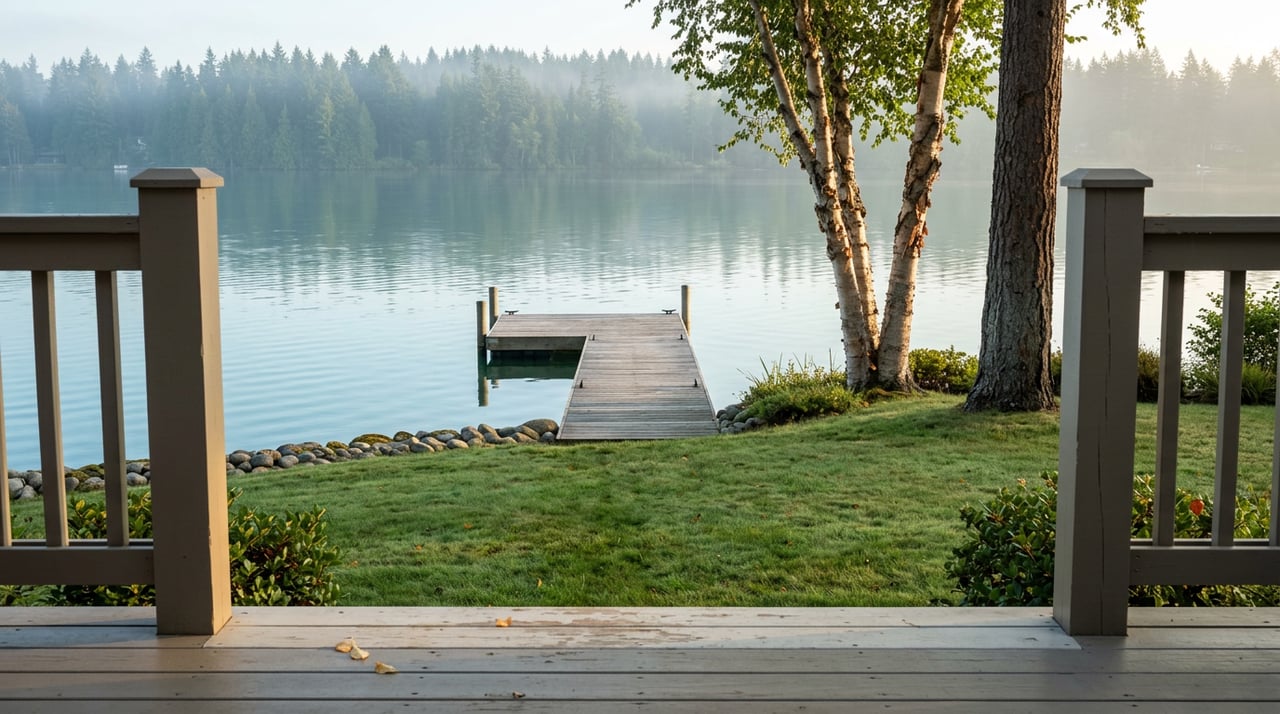
Buy a house on Hayden Lake and the deed transfers the moment you close. The dock attached to it does not, at least not automatically, and most buyers never find that out until the paperwork stalls or a neighbor objects to something they assumed was already settled.
That gap matters more this year than it has in a while. A new set of state rules took effect this summer, and a very public fight over Hayden Lake's only commercial marina showed earlier this year exactly how much scrutiny a dock permit can attract on this particular lake, even when the applicant follows every rule on the books.
The paperwork nobody hands you at the closing table
Every dock, buoy, or shoreline structure on Hayden Lake sits on state-owned lakebed, not on the private lot it's attached to. The Idaho Department of Lands issues the encroachment permit that allows it to be there, under the Lake Protection Act. When a property with an existing dock changes hands, that permit does not ride along with the deed by default. The seller and buyer are expected to file a Request for Assignment form and pay a $300 fee, submitted to the appropriate IDL Supervisory Area Office, before the new owner is the permit holder of record.
Skipping that step does not make the dock disappear, but it does leave a new owner holding a structure the state's paperwork still says belongs to someone else. An Idaho and Washington attorney who has represented lake property owners on both sides of the state line put it plainly in a piece for the Spokane Journal of Business: buyers should compare the diagrams on the recorded permit against what is actually built on the property, especially if a dock was rebuilt after ice or flood damage, and only after confirming that match should the seller assign the permit at closing. If no valid permit turns up, or the built structure doesn't match the one on file, the fix is applying for a new permit before you rely on the dock at all.
That is a slower, more paperwork-heavy process than most people expect from something that looks, from the shore, like a simple wooden platform.
Why the timing works against assumptions this year
Idaho's rules governing beds, waters, and airspace over navigable lakes were rewritten this year. The updated version, IDAPA 20.03.04, was approved by the 2026 Idaho Legislature and took effect July 1, 2026. Anyone closing on a Hayden Lake dock property this summer, or heading into fall, is doing so under a rulebook that changed mid-year, which is one more reason not to treat an existing permit as a formality. A permit that was compliant under the old standard is worth confirming against the new one before you count on it.
What a 216-slip fight taught the rest of the lake
The clearest evidence that Hayden Lake dock permitting is not a rubber stamp came from the marina itself, not from any private homeowner's dock.
Southern Marinas Hayden Lake, LLC, which has owned Hayden Lake Marina since 2021, filed an application with the Idaho Department of Lands in October 2025 to remove and replace the marina's existing docks. The plan would have added 32 slips to the marina's current 216, along with updated electrical service and a new pump-out facility, framed as a response to boats that now average well over 20 feet in length and a waiting list the marina said was substantial.
Reaction split fast. Some residents welcomed it. Andrea Zinnecker, who had been on the waitlist for years, called it a benefit to the lake and the community. Others weighed the tradeoffs more warily. Steve Petroni said the expansion would cost him part of his lake view but that reduced traffic made the tradeoff worth it. The Hayden Lake Watershed Association's board flagged concerns about parking, traffic on Hayden Lake Road, and the safety of moving fuel pumps farther from shore. A group calling itself Citizens Against Hayden Lake Marina Expansion organized formal opposition. Brookes Spencer, one of the objectors, said later that the pushback was never about opposing the marina itself, but about the scale of the plan and the near-total absence of community input over what he described as two and a half years of planning.
IDL scheduled a formal public hearing for April 15, with a notice period that gave residents until late February to file written objections. Then, on March 27, before the hearing ever happened, Southern Marinas withdrew its application entirely. The withdrawal followed a unanimous vote by the Hayden City Council days earlier to deny the marina's request for a letter of support. IDL's resource supervisor confirmed the hearing was canceled. As of early April, the marina's representatives said they were reassessing and had no timeline for resubmitting, revised or otherwise.
Why "no protected view" didn't save the project
Idaho case law is unambiguous on one point: littoral rights under the Lake Protection Act do not include a right to a particular view. That is the legal standard IDL applies when it weighs an encroachment against factors like navigation, habitat, and water quality.
The marina story shows how little that legal standard mattered once the political process got involved. The formal test IDL uses never got applied here, because the project stalled at the city council and neighborhood-opposition stage, long before a hearing officer ever weighed lake value factors against anything. A permit applicant can be entirely within their legal rights and still lose the practical fight if the surrounding community organizes against it.
That is the lesson worth carrying into a much smaller transaction. Your dock does not need to clear some abstract legal bar in a vacuum. It needs to clear it in a specific neighborhood, on a specific stretch of shoreline, where your neighbors have opinions and, as this case showed, real leverage.
What this means for a single-family dock, not just a marina
Private, single-family docks go through a lighter version of the same process, but it is the same process. If a proposed dock sits within 25 feet of the shared littoral right line with a neighboring parcel, IDL notifies that neighbor by certified mail. For an ordinary single-family dock within the established line of navigability, IDL still gives adjacent waterfront owners notice of the application. If a neighbor objects and no agreement gets reached, the file moves to a formal administrative hearing, the same kind of hearing the marina was about to face.
There is one meaningful difference in your favor. Single-family and two-family dock applications processed under the noncommercial standard generally move on a faster internal clock than commercial or community dock applications, which have no such deadline and instead must hold any required hearing within 90 days of a completed application. A quiet, uncontested single-family dock permit tends to move faster than a contested commercial one. But "quiet and uncontested" is exactly the condition a buyer needs to verify, not assume.
A short list worth working through before you write an offer
- Ask for the recorded IDL permit number and compare its dimensions and configuration against what is physically built, particularly if the dock was replaced after storm or ice damage.
- Confirm the dock falls within the standard size cap of 700 square feet and 10 feet of width, excluding any slip cutout, since anything larger may have needed a separate variance.
- If the dock predates 1975, ask whether the seller has documentation, aerial photos, tax deeds, or similar records, showing it hasn't been modified since, which can qualify it for fee-free permitting.
- Plan for the Request for Assignment form and $300 fee as a line item in your closing checklist, not an afterthought.
- Ask whether any neighboring dock, buoy, or shoreline structure nearby has an open objection or pending hearing with IDL, since that can signal how contested the surrounding shoreline is.
Frequently Asked Questions
Does a dock permit automatically transfer when I buy a Hayden Lake home? No. The Idaho Department of Lands requires a Request for Assignment form and a $300 fee to move the permit of record from seller to buyer.
What if the dock was rebuilt after ice or storm damage? Compare the current structure against the dimensions and layout on the recorded permit. A rebuilt dock that no longer matches the permit on file may need a new application rather than a simple assignment.
Do single-family docks face the same public notice and hearing process as the marina did? On a smaller scale, yes. Adjacent owners get notice of the application, and an unresolved objection can trigger a formal hearing, though single-family applications generally move faster than contested commercial ones.
Will the Hayden Lake Marina expansion come back? As of the most recent reporting in April 2026, the applicant had paused the project with no announced timeline for resubmission, so the outcome remains unsettled.
Hayden Lake rewards buyers and sellers who ask the right questions early, especially where the shoreline is involved. If you are weighing a purchase or a listing on the water and want a clear-eyed read on what the paperwork actually says before you're under contract, Natalie Priebe is glad to walk through it with you.